

How to Write Prompts for Short-Form Video Hooks
July 14, 2026
How to Launch Any AI Tool in One Click from Chrome
July 14, 2026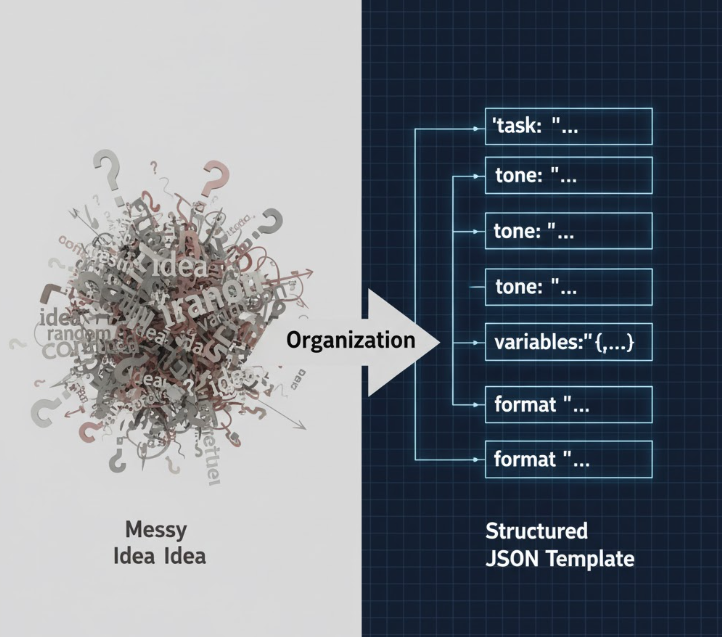
Introduction
If you’ve ever struggled with inconsistent AI outputs or messy prompts, you’re not alone. Many creators and teams face challenges when prompts are unstructured or inconsistent, leading to unpredictable AI responses. This is where a JSON-based prompt template comes in. By leveraging structured prompts, you can improve clarity, consistency, and control over AI-generated content.

What Is a JSON Prompt Template?
A JSON prompt template is a structured format for designing AI prompts using JavaScript Object Notation (JSON). Unlike traditional plain-text prompts, JSON templates clearly define variables, instructions, and response expectations.
Benefits of JSON prompt templates:
- Clarity: Each component of your prompt is labeled and organized.
- Reusability: Templates can be reused across projects or by team members.
- Consistency: Structured prompts reduce variation in AI outputs.
- Automation-Friendly: Easily integrated into AI workflows or software tools.
Example:
{
  "task": "Write a product description",
  "product_name": "Smart Water Bottle",
  "tone": "friendly and informative",
  "length": "150 words"
}
How JSON Prompt Templates Work
- Define Variables: Identify the inputs your AI needs (e.g., product name, audience, tone).
- Set Instructions: Specify exactly what the AI should do.
- Structure for Readability: Use JSON keys to separate each element.
- Integrate With Tools: JSON can be used in automation tools, APIs, or prompt managers like My Magic Prompt.
By separating content from structure, teams can standardize their AI operations and reduce errors.
When to Use JSON-Based Prompts
- Team Collaboration: Standardize prompts so multiple users get consistent outputs.
- Complex Tasks: When prompts have multiple variables or steps.
- Automation Pipelines: For AI workflows where inputs and outputs are processed programmatically.
- Version Control: Track changes to prompts in a readable format for auditing.
How My Magic Prompt Simplifies JSON Templates
My Magic Prompt allows creators to easily build, store, and manage JSON prompt templates without manually writing JSON. Features like the Prompt Builder and Template Library help you:
- Generate structured prompts quickly.
- Store templates for reuse across projects.
- Export prompts for automation in AI workflows.
FAQ
Q1: What’s the difference between a standard prompt and a JSON prompt template?
A: A standard prompt is free-form text, while a JSON template structures inputs and instructions clearly, improving consistency.
Q2: Can beginners use JSON prompt templates?
A: Yes. Tools like My Magic Prompt make it simple without requiring programming knowledge.
Q3: How does JSON improve team collaboration?
A: JSON standardizes prompts so multiple users can generate consistent AI outputs.
Q4: Are JSON prompt templates compatible with all AI platforms?
A: Most AI models accept text-based JSON instructions, and My Magic Prompt ensures compatibility with platforms like ChatGPT, Claude, and Gemini.
Q5: Can JSON templates include variables for dynamic content?
A: Absolutely. JSON allows placeholders for dynamic input, making prompts flexible and reusable.
Q6: How do I version control JSON templates?
A: Store your JSON files in version control systems like Git to track changes over time.
Conclusion
JSON-based prompt templates are a game-changer for creators and teams looking to improve AI prompt quality, consistency, and automation. With tools like My Magic Prompt, you can effortlessly create, manage, and deploy structured prompts, turning chaotic AI workflows into a streamlined, predictable process.
Explore My Magic Prompt today to start building your own JSON-based prompt templates and elevate your AI productivity.