

How to Use Prompt Templates for Faster Client Communication
May 11, 2026
How to Build Prompts for Better Workshop Facilitation
May 11, 2026
✍️ Introduction: Why Persona Prompts Matter More Than Ever
If you’ve ever asked ChatGPT or Claude to “write like a marketer,” you’ve probably seen wildly different results — sometimes brilliant, sometimes bland. That inconsistency isn’t random — it’s because your AI doesn’t know who it’s supposed to be.
That’s where persona prompts come in. By defining a clear “who” behind your AI’s voice, you turn generic answers into specific, on-brand, and strategically aligned output. And the secret? Structuring your persona prompts with three powerful layers: Role, Goal, and Constraint.
In this post, we’ll break down each layer with examples you can copy directly into My Magic Prompt — your go-to toolkit for creating smarter, reusable prompt templates.
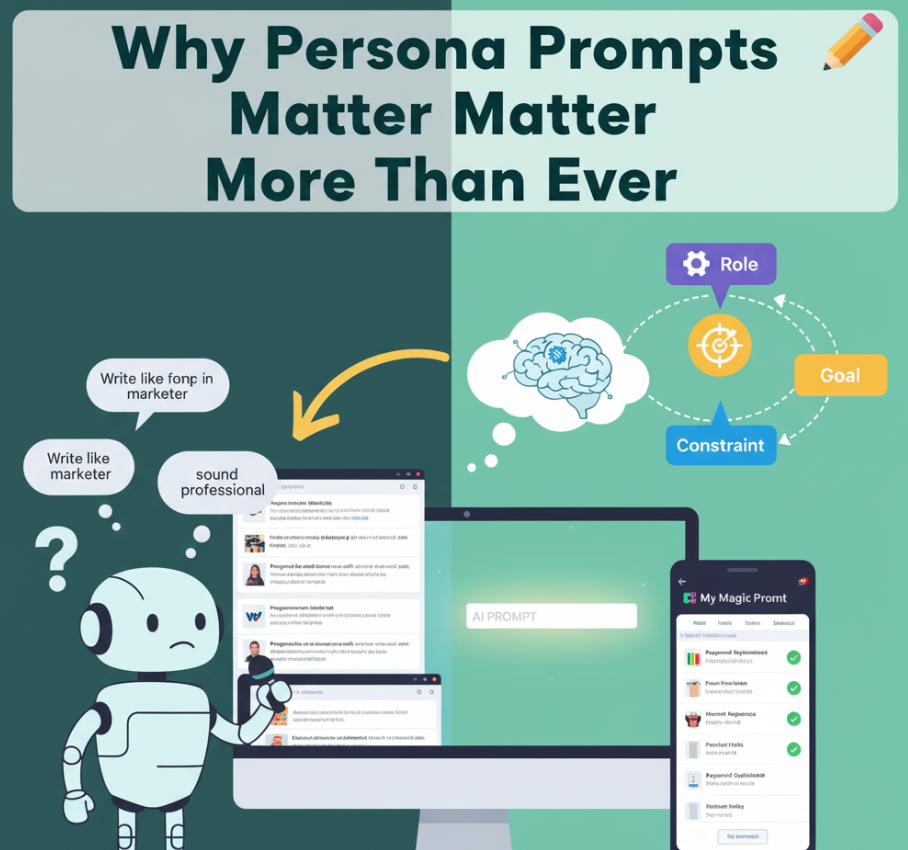
🧩 The 3 Layers of the Perfect Persona Prompt
1. The Role Layer — Define the AI’s Professional Identity
Your persona starts with who the AI should act as. Instead of saying “write a blog,” say:
“Act as a senior SaaS content strategist who understands B2B buyer psychology and conversion copy.”
Why it matters: This gives context. It sets expertise, tone, and domain knowledge so your AI writes like a peer, not a novice.
Example prompt:
Act as a senior digital marketer at a growth-stage SaaS startup. You understand buyer personas, positioning, and content funnels.
Pro Tip: In My Magic Prompt, save your Role layer as a reusable block using the Prompt Template Builder, so every new prompt starts from the same professional context.
2. The Goal Layer — Tell AI What Outcome to Achieve
Once the role is defined, clarify the intent — what success looks like. Without it, the AI might generate great text that doesn’t move the needle.
Example prompt:
Your goal is to write a blog post that educates readers about prompt engineering while positioning our tool as a thought leader.
Checklist for strong Goal layers:
- 🎯 Clear deliverable (email, blog, strategy, etc.)
- 💡 Audience focus (who it’s for)
- 🧠 Intent clarity (inform, persuade, convert)
Example Structure:
Your goal is to [DO THIS] for [AUDIENCE] to achieve [OUTCOME].
3. The Constraint Layer — Add Boundaries for Precision
The third layer sharpens your results by adding style, tone, and formatting constraints. This keeps your AI aligned with your brand’s standards.
Example constraints:
- Tone: friendly, concise, professional
- Length: 500 words max
- Format: include H2 headers and bullet points
- Style: avoid jargon, use active voice
Example prompt:
Write in a confident, conversational tone. Keep sentences under 20 words. Include examples and avoid generic filler.
Pro Tip: Using the Magic Prompt Chrome Extension, you can layer constraints visually using its structured blocks — perfect for non-technical users.
🧠 Putting It All Together: The Full Persona Prompt Template
Here’s how the three layers combine:
Act as a senior SaaS content strategist who understands B2B buyer psychology and conversion copywriting.
Your goal is to write a LinkedIn post that educates founders about how AI can improve marketing workflows.
Write in a friendly, confident tone under 150 words, with one call-to-action and two relevant hashtags.
💡 Try this structure inside My Magic Prompt to quickly build reusable persona templates — perfect for content teams, marketers, or agencies scaling with AI.
🛠 Why Structured Persona Prompts Improve Marketing Output
A well-structured persona prompt leads to:
- Consistency: Every AI output aligns with your brand’s voice.
- Efficiency: You save time rewriting or editing.
- Scalability: Your team can use one shared prompt template across campaigns.
📍 For marketers juggling multiple brand voices, the Prompt Template Library in My Magic Prompt lets you organize personas by product, audience, or platform.
❓ FAQ: Persona Prompts & Marketing AI
1. What is a persona prompt?
A persona prompt tells AI who it’s supposed to be, giving structure and tone to its output.
2. What makes a persona prompt effective?
It combines role clarity, a clear goal, and precise constraints for consistency and relevance.
3. How can I reuse persona prompts?
Use My Magic Prompt’s template builder to store and customize persona structures for different campaigns or clients.
4. What’s the difference between a persona prompt and a role prompt?
A role prompt sets identity only; a persona prompt adds goal and constraint layers for context and precision.
5. How can I organize my persona prompts?
Inside My Magic Prompt, use folders or tags like “B2B,” “Social Media,” or “Brand Voice” to stay organized.
🤍 Closing Thoughts
Persona prompts are the foundation of strategic AI writing. Whether you’re crafting brand campaigns, social content, or emails — defining Role, Goal, and Constraint transforms “random AI copy” into reliable marketing output.
If you’re ready to build smarter, structured persona prompts, explore My Magic Prompt — your all-in-one AI productivity toolkit for marketers and creators.