

How to Build Prompts for Better Product Messaging
July 8, 2026
How to Save Your Best Prompts (And Why It’s Essential)
July 9, 2026
✍️ Introduction: The Problem With One-and-Done Prompts
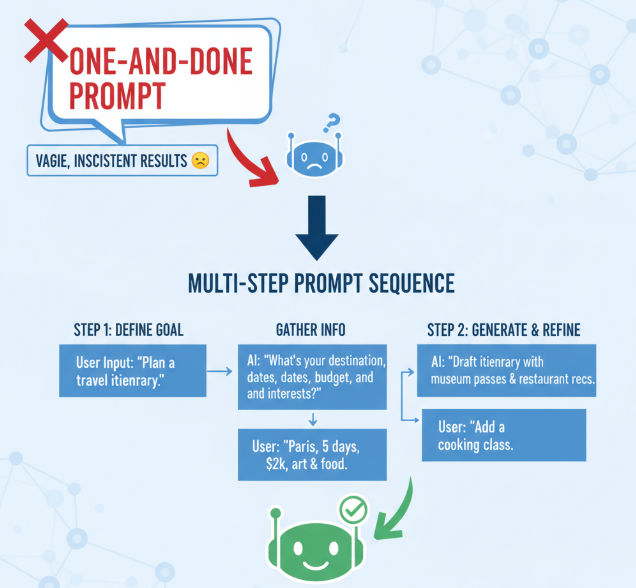
If you’ve ever typed a single prompt into ChatGPT or Claude and hoped for a perfect result… you already know how hit-or-miss AI can be. One-shot prompts often produce vague answers, inconsistencies, or results that miss the mark.
That’s where multi-step prompt sequences change everything.
By structuring your workflow into deliberate steps, you help AI think, organize, and reason — leading to dramatically more accurate, useful, and reliable output. Tools like My Magic Prompt make this process even easier by guiding users through structured prompting without needing to build everything from scratch.
📚 What Are Multi-Step Prompt Sequences?
Prompt sequences (also known as multi-step prompts or structured prompting) are a series of connected instructions you give to an AI model. Each step builds on the previous one, helping the model refine context, gather requirements, and produce a stronger final result.
Think of it like:
- Step 1: Define the goal
- Step 2: Collect the inputs
- Step 3: Draft the output
- Step 4: Improve or refine
Instead of asking AI to “do everything at once,” you break complex tasks into manageable phases.
🔍 Why Multi-Step Prompting Matters
Here’s why the smartest creators, marketers, and operators use structured prompting:
1. More accurate results
Each step gives the model clarity — reducing hallucinations and guesswork.
2. More control over tone, style, and format
Instead of editing messy drafts, you shape the output as you go.
3. Better performance on complex tasks
Research from OpenAI and other labs shows that step-by-step prompting improves reasoning and consistency.
4. More repeatability and automation
With tools like the My Magic Prompt Chrome Extension, you can save sequences, reuse them, or share workflows with your team.
🧩 How to Build a Simple Multi-Step Prompt Sequence
Here’s a starter framework you can copy:
Step 1 — Clarify the Goal
“What outcome do I want? What does a great result look like?”
Step 2 — Gather Inputs
Provide examples, audience details, brand voice, constraints, etc.
Step 3 — Generate the First Draft
Ask AI to produce an initial version — without aiming for perfection.
Step 4 — Refine With Constraints
Add improvements: tone, structure, accuracy, formatting.
Step 5 — Final Polish
Ask for a concise summary or final optimized version.
Want this automated? My Magic Prompt’s Prompt Builder helps you create step-by-step workflows without writing everything manually.
🛠 Where My Magic Prompt Fits In
My Magic Prompt helps users:
- Build multi-step prompt sequences visually
- Use pre-made structured templates
- Reduce errors or inconsistencies
- Save time on repetitive workflows
❓ FAQs
What’s the difference between a one-shot prompt and a multi-step prompt?
One-shot prompts try to get everything done at once. Multi-step prompts guide the AI through stages, producing more reliable results.
Do multi-step prompts work in all AI models?
Yes — ChatGPT, Claude, Gemini, and others all improve when guided through sequences.
How do I organize my prompts?
Use folders, templates, or a tool like My Magic Prompt to keep everything accessible.
Can prompt sequences automate my workflow?
Absolutely. Once you build a sequence, you can reuse it for writing, research, planning, or creative tasks.
Why does AI perform better with structured prompts?
Because breaking tasks into steps mirrors human reasoning — improving clarity and reducing errors.
🤍 Soft CTA
If you want to create better prompts faster, explore My Magic Prompt for templates, guided prompt sequences, and productivity workflows that help you get more from every AI model.