
12 Time-Saving Prompts for Google Sheets Formulas with AI
June 4, 2026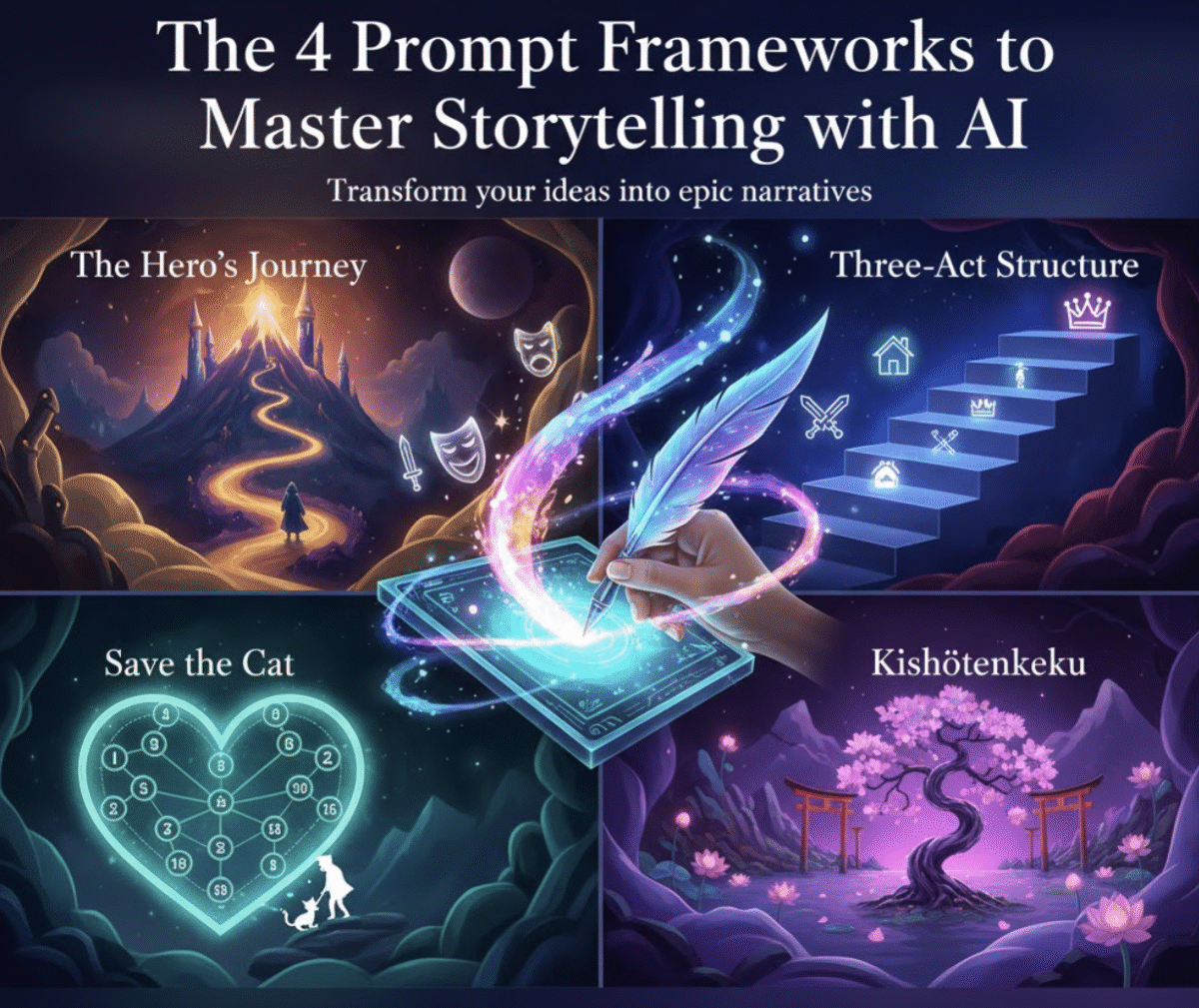
✍️ Introduction: From Blank Page to Brilliant Story — with AI
Every storyteller knows the struggle: a blank page, a half-formed idea, and the elusive spark of a great story. But what if AI could help you structure, expand, and polish your story ideas faster — without losing your creative voice?
With the right AI prompts for storytelling, tools like ChatGPT, Claude, or Gemini can become your creative collaborator — helping you outline character arcs, test dialogue, or even remix mythic story structures.
This guide walks you through four proven storytelling frameworks — and shows you how to apply each one directly in your prompts using My Magic Prompt. Whether you’re a novelist, screenwriter, or creator exploring narrative AI, these prompt techniques will help you go from idea to impact, faster.
🎬 1. The Hero’s Journey Framework
Best for: Epic adventures, fantasy, and transformation stories
The Hero’s Journey — made famous by Joseph Campbell — follows a character through transformation, trials, and triumph. It’s perfect for generating rich, character-driven stories.
Prompt Example:
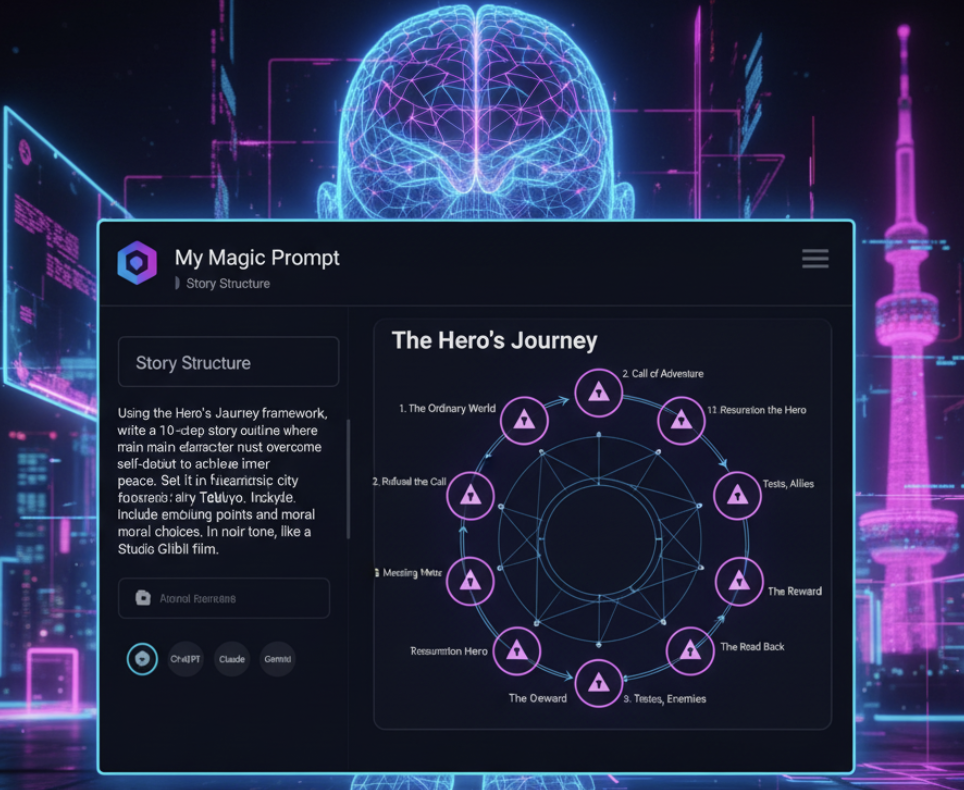
Using the Hero’s Journey framework, write a 10-step story outline where the main character must overcome self-doubt to achieve inner peace. Set it in a futuristic city inspired by Tokyo. Include emotional turning points and moral choices.
AI Tip: Add details about tone and genre (“in a noir tone” or “like a Studio Ghibli film”) to help your AI model match your storytelling style.
In My Magic Prompt: Save this as a reusable Prompt Template under the “Story Structure” category so your team or co-writers can quickly build outlines using the same structure.
💔 2. The Three-Act Structure
Best for: Screenwriters, short fiction, and pacing-driven stories
The Three-Act Structure simplifies your story into: Setup → Confrontation → Resolution. It’s easy to apply across genres and AI models.
Prompt Example:
Write a Three-Act Structure story about an introverted coder who accidentally creates a sentient AI. Show her emotional growth across all three acts. Include clear plot beats and act transitions.
Pro Tip: Pair this with My Magic Prompt’s Prompt Builder to add variables like “genre,” “tone,” or “setting,” so you can quickly remix your stories.
In My Magic Prompt: Combine it with the AI Toolkit to chain multiple prompts — one for the outline, another for character arcs, and another for dialogue refinement.
🔄 3. The Save the Cat Beat Sheet
Best for: Writers who want structured but emotional storytelling
The Save the Cat framework (by Blake Snyder) breaks down stories into 15 beats that keep readers emotionally invested.
Prompt Example:
Using the Save the Cat framework, write a detailed story outline for a romantic comedy where two rival entrepreneurs are forced to collaborate. Include the 15 beats and emotional highs/lows.
AI Tip: Use MagicPrompt’s Prompt Sync feature to share your customized Save the Cat prompt templates across your writing group or studio team.
🌌 4. The Kishōtenketsu Framework
Best for: Non-Western, contemplative, or thematic storytelling
Kishōtenketsu (a classic East Asian narrative model) uses contrast instead of conflict. It’s ideal for slice-of-life stories, allegories, and poetic narratives.
Prompt Example:
Using the Kishōtenketsu framework, generate a 4-part short story where an AI learns about humanity through gardening. Focus on tone, subtle tension, and emotional resonance rather than conflict.
Why it works: It teaches AI to build tension through theme and imagery, not just plot.
In My Magic Prompt: Tag this under your “Nonlinear Stories” or “Creative Writing” folders using the AI Prompt Library, so you can reuse and remix it later.
⚙️ How to Apply These Frameworks in My Magic Prompt
With My Magic Prompt, you can:
- 🧩 Build Reusable Story Templates: Save your best frameworks once, then auto-generate new stories with one click.
- 🤝 Share Prompts Across Teams: Use MagicPrompt Sync to collaborate with co-writers or editors.
- 🚀 Enhance Productivity: Quickly switch between AI models (ChatGPT, Claude, Gemini) using the Magic Prompt Chrome Extension.
❓FAQ: AI Prompts for Storytelling
1. What’s the difference between AI story ideas and AI story frameworks?
Story ideas are starting points; frameworks give structure and direction — ensuring every prompt produces a complete, cohesive story.
2. Can AI understand character emotions or arcs?
Yes — if you guide it with structured prompts (e.g., “show emotional change between acts” or “highlight moral conflict”).
3. How can I make AI-generated stories sound more human?
Add tone and sensory details to your prompt: “Describe the feeling of rain hitting the character’s skin as she decides to leave.”
4. What’s the best AI tool for writers?
Try multiple — ChatGPT for dialogue, Claude for nuance, Gemini for concept ideation — and manage all your prompts easily with My Magic Prompt.
5. How can I organize my AI storytelling prompts?
Use folders and tags inside My Magic Prompt’s Prompt Library — group them by framework, genre, or writing stage.
🤍 Closing Thoughts
AI doesn’t replace creativity — it amplifies it. When paired with proven frameworks like the Hero’s Journey or Save the Cat, AI becomes your story co-pilot — helping you generate, refine, and explore ideas faster than ever.
If you’re ready to take your storytelling prompts to the next level, explore the Prompt Builder and Story Framework Templates on My Magic Prompt — your creative edge for writing smarter, not harder.