

How to Build Prompts for Better Testimonials and Review Requests
July 9, 2026
How to Build Prompts for Faster Decision Memos
July 9, 2026
✍️ Introduction: Why Your AI Results Keep Changing
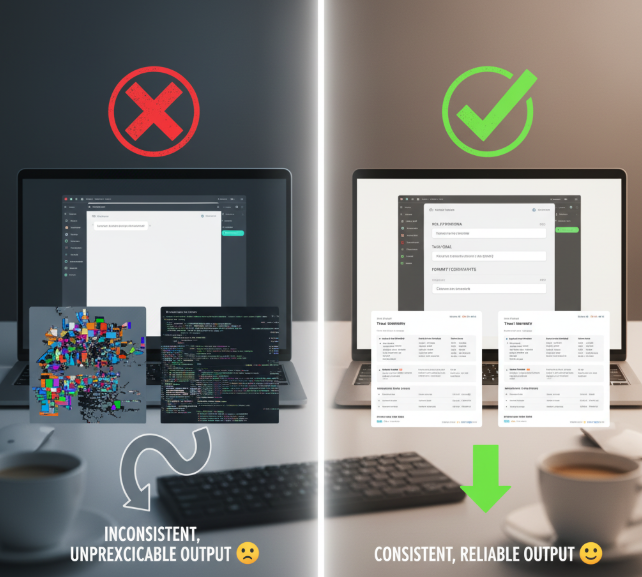
If you’ve ever run the same prompt twice and gotten two totally different outputs, you’re not alone. Consistency is one of the biggest challenges AI users face — especially when you’re creating content, workflows, or assets at scale.
The good news? Consistent results aren’t about luck. They come from using structured, reliable prompts that remove ambiguity. And when you master the formula, your AI becomes predictable, repeatable, and far more powerful.
📚 What Makes a Prompt Deliver Consistent Results?
To get reliable prompts, you need a structure that’s clear, constrained, and repeatable. A strong prompt intentionally reduces randomness.
Here’s the foundational structure:
1. Role Setting
AI behaves more consistently when given a defined identity.
- “Act as a senior UX writer…”
- “You are an AI productivity coach…”
2. Clear Instructions
Spell out exactly what you want.
- Format (blog, outline, script, table)
- Perspective (1st/3rd person)
- Tone (friendly, concise, expert)
3. Constraints
These are the guardrails that prevent drift:
- Word counts
- Required sections
- Forbidden elements
- Style rules
4. Expected Output Examples
If you show it a sample, consistency skyrockets.
5. Evaluation Criteria
Tell the AI how to check its own work.
- “Verify the output follows all constraints before returning.”
🧩 The Reliable Prompt Framework (RPF)
Use this checklist whenever you want consistency:
| Step | What to Include | Why It Works |
|---|---|---|
| 1. Role | Who the AI is | Reduces ambiguity |
| 2. Task | What you want | Eliminates guesswork |
| 3. Format | Structure of the output | Ensures repeatability |
| 4. Constraints | Rules + limits | Creates consistency |
| 5. Examples | Sample input/output | Tightens alignment |
| 6. Quality Check | Self-review instructions | Reduces errors |
🛠 How My Magic Prompt Helps You Write More Consistent Prompts
Instead of rebuilding prompt structures from scratch, My Magic Prompt makes consistency effortless by giving you:
- Pre-built prompt templates with best‑practice structure
- A prompt builder that ensures you include roles, constraints, and instructions
- Saved prompt systems you can reuse across projects
- A Chrome Extension that lets you insert consistent prompts instantly
Explore the tools:
- Homepage: https://mymagicprompt.com
- Magic Prompt Chrome Extension: https://chromewebstore.google.com/detail/magicprompt-ai-prompt-gen/ghdgomagaddmjobokcodgmddfnlbcgko?utm_source=item-share-cb
- Prompt Builder & Templates: Inside the product features section
🔍 Examples of Consistent vs. Inconsistent Prompts
❌ Inconsistent Prompt
“Write a social media caption about productivity.”
✅ Consistent Results Prompt
“Act as a productivity strategist. Write a 2‑sentence Instagram caption encouraging entrepreneurs to batch their tasks. Use a friendly, concise tone. Include one emoji. Do not include hashtags.”
❓ FAQ: Writing Prompts That Produce Reliable Results
1. What’s the difference between a good and bad prompt?
A good prompt is structured, specific, and includes constraints. A bad prompt leaves interpretation open.
2. How can I make my prompts more consistent?
Use a framework with role, instructions, constraints, examples, and quality checks.
3. Should I use examples in prompts?
Yes — examples dramatically improve consistency and reduce errors.
4. How can I organize and reuse my best prompts?
Tools like My Magic Prompt let you save, edit, and repurpose your top-performing prompts.
5. Why does AI occasionally give inconsistent results even with good prompts?
LLMs have probabilistic behavior, but structured prompting minimizes variation.
6. Do longer prompts give more consistent results?
Not always — clarity matters more than length.
🤍 Soft CTA
If you want more structured templates, smarter workflows, and a faster way to build consistent prompts, explore My Magic Prompt for ready-made systems and AI productivity tools that save you hours.